

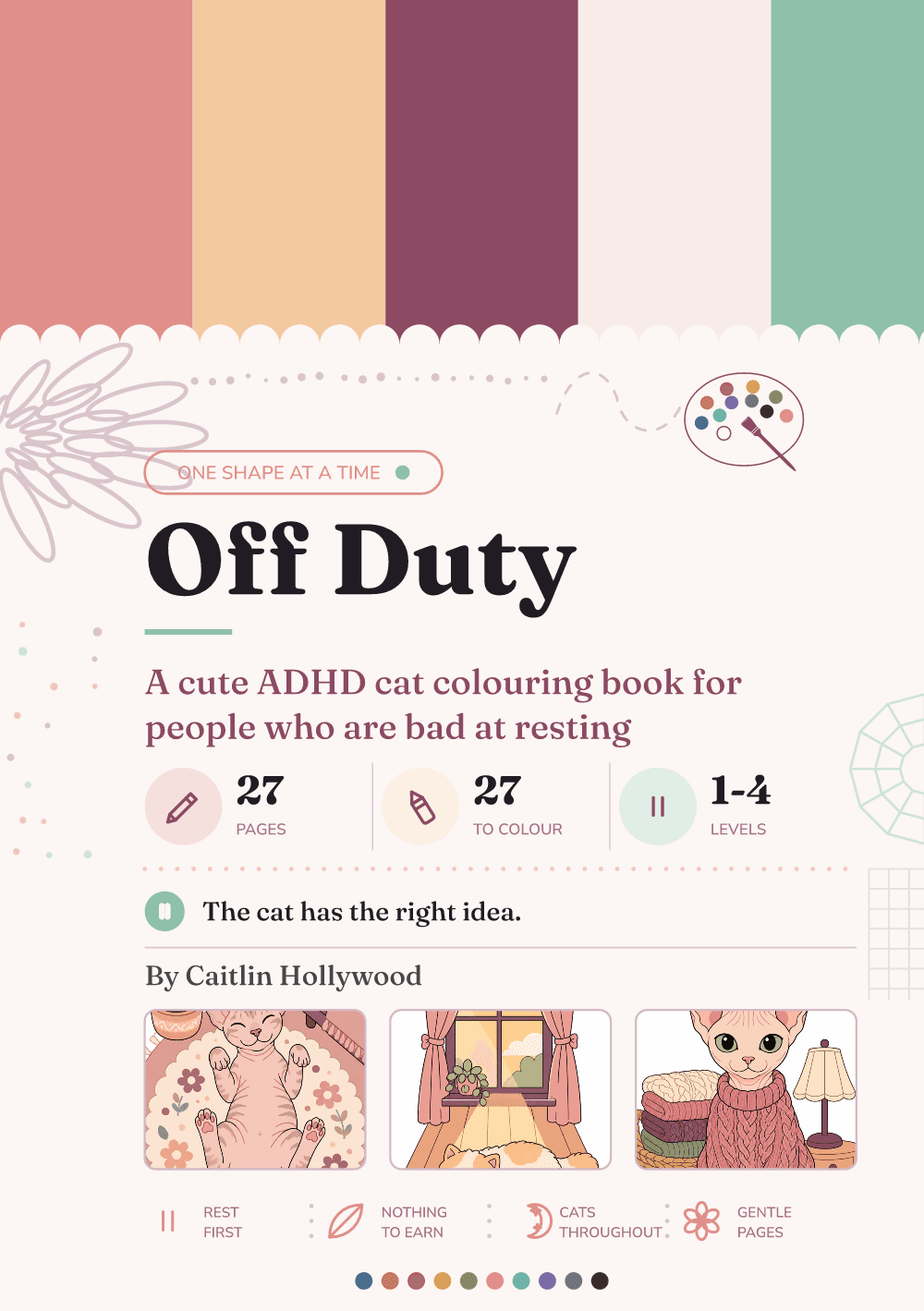
Off Duty
A cute ADHD cat colouring book for people who are bad at resting
Cover palette, one of 10 in the book
- Blush
- Apricot
- Plum
- Chalk
- Mint
Every design faces a guide page carrying five colours already chosen for it, and the book works through 10 different palettes, so no two pages hand you the same decision. They are suggestions. Ignoring them completely is a perfectly good way to use the book.
- 27
- Pages
- 27
- To colour
- 0
- To solve
- A5
- Size
A PDF, by email, to the address you give at checkout.
You have been going since you woke up, you still feel behind, and the idea of sitting down before the list is finished feels like getting away with something. Most people I work with can accept that rest is allowed on somebody else's behalf and not on their own.
So this is a book of cats, who have never once had that problem. Twenty seven pages of them in sunbeams, in cardboard boxes and flat out on the carpet, at A5, coil bound so it lies flat on your knee. Nothing in it needs more than a pencil, and nothing in it needs you to finish.
The pages get gentler as the book goes on, so if today has already gone badly you can start at the back. Every page carries a badge before you begin: how many decisions it asks for, and roughly how many minutes it takes.
And every left hand page is a guide to the design facing it: five colours already chosen with their names, one short line about rest, one practical thing I actually say in mentoring sessions, and a line giving you permission to stop.
Two of the cats are mine
Dobby and Binx are my own sphynxes, drawn from photographs, and they turn up on eight pages between them. Dobby is the peach one who dresses up. Binx is the darker one with the enormous ears who is usually asleep. They wear jumpers because hairless cats get cold, not because it is a costume.
The reverse of every page is the useful bit
Colouring books are printed single sided so ink does not bleed through, and every other one on the shelf leaves that reverse blank. This one uses it. Facing each design is its colour guide, a short line about rest, an ADHD tip that belongs to that page, and a permission line.
It gets gentler as it goes
The front of the book is busy, because that is what those pages are about: the list, the chair of clothes, the washing up. The back is a cat and very little else. If today has already gone badly, start at the end.
There is nothing to solve
No mazes, no puzzles, nothing with a correct answer. That is deliberate in a book about not having to earn your rest, and it is why the third number on the cover is the effort range rather than a count of puzzles.
Look inside
5 real pages out of 60, exactly as they print. Swipe, or use the arrows.
Drag across the shapes to colour them, or tap one to fill it and tap again to clear it. On the maze, drag to draw and the walls will stop you. Every page has its own five colours, so the same button is a different colour on a different page.
5 pages previewed, from 60 in the book
What the levels mean
Every design carries one of these before you start it, so you can pick a page that matches today rather than starting at the front. The dots count decisions, not detail.
- 5 min. Almost no choices. Big shapes, lots of air.
- 10 min. A clear rhythm. You can stop mid row.
- 15 min. Enough going on to hold your attention.
- 25 min. A proper sit down page.
- 40 min. For an evening when you have the capacity.
If you are here, these might help too
- ADHD Is Not Laziness: The Neuroscience of Why You Can't 'Just Do It'ADHD is not laziness. Executive dysfunction explained, why motivation works differently, and how to explain it to people who do not get it.
- The ADHD Burnout Cycle: Why You Keep CrashingHow the ADHD burnout cycle works, from procrastination to paralysis and poor sleep, why standard burnout advice fails, and how to break it.
- AuDHD Burnout: Why It Hits Harder and Takes Longer to Recover FromAuDHD burnout explained. Why ADHD plus autism creates a unique burnout pattern, signs to watch for, and practical recovery strategies for autistic ADHDers.
- ADHD Fatigue: Why You're Always Exhausted (Even After Sleeping)ADHD fatigue goes beyond normal tiredness. Why ADHD leaves you drained, how it links to sleep and burnout, and what actually helps.
- ADHD and Self-Care: Why the Basics Feel So HardSelf-care with ADHD is not bubble baths. Why showering, eating and sleeping are harder with ADHD, and practical strategies that help.
- ADHD and Perfectionism: The Paralysis Nobody Talks AboutADHD and perfectionism create a paralysing cycle of all-or-nothing thinking and avoidance. Why they pair up, and how to break the cycle.
Questions about Off Duty
Is this actually about ADHD, or is it just cats?
Both, and the cats are the argument rather than the decoration. Every left hand page carries something I say in mentoring sessions about rest: why you cannot sit down until the list is finished, why tiredness turns up as irritability, why the chair of clothes is genuinely fine. The cats are there because they are the only ones in the house who have never felt guilty about lying down.
What is actually in it?
Twenty seven pages, all of them to colour. Nothing to solve and nothing to work out. Plus front and back matter, so sixty printed pages in total.
Who are Dobby and Binx?
My cats. They are sphynxes, which means hairless, and they turn up on eight pages between them wearing various things. Dobby is the peach one, Binx is the darker one with the ears. The other nineteen pages are cats I made up.
Do I need special pens?
No. Coloured pencils and gel pens suit the paper best. Alcohol markers will show through to the reverse, and the reverse is a guide page rather than another design, so nothing is spoiled if they do.
How is this different from your other books?
Same format and same guide pages, different problem. Waiting Mode is for time you cannot use, Wind Down is for the end of the day and Too Much is for sensory overload. Those are situations. This one is about rest and the guilt around it, which is a thing rather than a time, so you can open it whenever it applies.
Do I have to finish it?
No, and the book says so on every single page. Twenty seven pages is deliberately short, and given what this one is about it would be a strange book to feel behind on.
The tips in this book come out of real sessions
Every guide page carries one thing I actually say to people I mentor. If they land, the sessions themselves go a great deal further, because a book cannot ask you a follow up question. The first step is a 15-minute discovery call.