

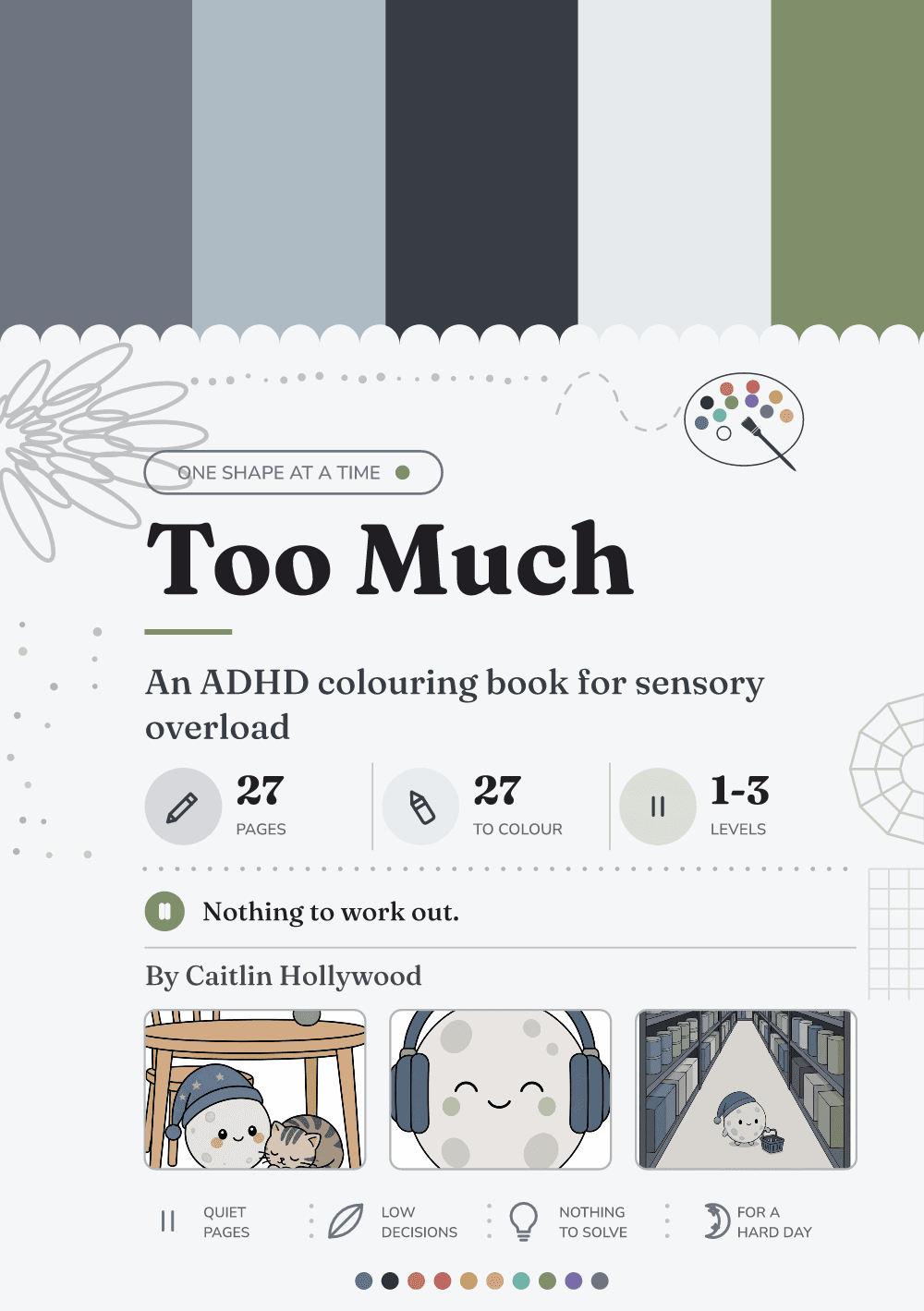
Too Much
An ADHD colouring book for sensory overload
Cover palette, one of 10 in the book
- Slate
- Mist
- Charcoal
- Pearl
- Moss
Every design faces a guide page carrying five colours already chosen for it, and the book works through 10 different palettes, so no two pages hand you the same decision. They are suggestions. Ignoring them completely is a perfectly good way to use the book.
- 27
- Pages
- 27
- To colour
- 0
- To solve
- A5
- Size
A PDF, by email, to the address you give at checkout.
Some days the world is turned up too loud. The supermarket, strip lights, a hand dryer going off beside you, four people talking at once, and a label in the back of a jumper you cannot stop noticing. None of it is dramatic and all of it adds up.
So every page in this book is one of those, drawn with almost nothing in it. Twenty seven pages to colour, at A5, coil bound so it lies flat on your knee. Nothing in it needs more than a pencil, and there is nothing anywhere to work out.
It stops at level three on purpose. A page that asks for a whole evening is the wrong thing to hand somebody who has had enough by four in the afternoon, so the two hardest levels in the range are simply not in here. The pages get emptier as the book goes on.
Every left hand page is a guide to the design facing it: five colours already chosen with their names, one practical thing I actually say to people in mentoring sessions about sensory overload, and a line giving you permission to stop.
It names the thing
Every page is a situation that is genuinely too much: the supermarket, strip lights, a hand dryer, a label in a jumper. Most books for overwhelm avoid the subject and offer flowers instead. This one says out loud that a supermarket is hard, and then hands you the quietest page in the range to sit with while it does.
The reverse of every page is the useful bit
Colouring books are printed single sided so ink does not bleed through, and every other one on the shelf leaves that reverse blank. This one uses it. Facing each design is its colour guide, an ADHD tip about sensory overload that belongs to that page, and a permission line.
It stops at level three
Each design carries an effort level and a time in minutes, and the levels count DECISIONS rather than detail. The top two levels in the range are missing here rather than forgotten: a page that asks for a whole evening is the wrong thing to hand somebody who has had enough by four in the afternoon.
Nothing to solve
No mazes, no puzzles, nothing with a correct answer, which is why the third number on the cover is the effort range instead. When you are overstimulated, parsing a puzzle is work.
Look inside
5 real pages out of 60, exactly as they print. Swipe, or use the arrows.
Drag across the shapes to colour them, or tap one to fill it and tap again to clear it. On the maze, drag to draw and the walls will stop you. Every page has its own five colours, so the same button is a different colour on a different page.
5 pages previewed, from 60 in the book
What the levels mean
Every design carries one of these before you start it, so you can pick a page that matches today rather than starting at the front. The dots count decisions, not detail.
- 5 min. Almost no choices. Big shapes, lots of air.
- 10 min. A clear rhythm. You can stop mid row.
- 15 min. Enough going on to hold your attention.
- 25 min. A proper sit down page.
- 40 min. For an evening when you have the capacity.
If you are here, these might help too
- ADHD and Sensory Processing: Why Everything Feels Too MuchMany ADHD adults experience sensory sensitivities. Learn about sensory overload, under-stimulation, misophonia, and practical coping strategies.
- ADHD and Misophonia: Why Certain Sounds Make You Want to ScreamMisophonia and ADHD often overlap. Why sound sensitivity is common with ADHD, the usual triggers, and what helps at work and at home.
- ADHD and Auditory Processing: Hearing but Not RetainingADHD can make spoken information hard to follow. Learn about attention, working memory, auditory processing, useful adjustments and when to seek assessment.
- ADHD Meltdowns in Adults: Why They Happen and How to CopeADHD meltdowns in adults are real and overwhelming. Learn what triggers them, how they differ from tantrums, and practical strategies to manage and recover.
- ADHD Shutdown vs Meltdown vs Burnout: What Is the Difference?Compare ADHD shutdown, meltdown and burnout. Learn how triggers, duration and recovery needs differ, what helps in the moment and when to seek support.
- ADHD and Overthinking: Why Your Brain Will Not Let Things GoADHD overthinking explained. Learn why thoughts race, branch and loop, how it differs from anxiety and rumination, and practical ways to quiet your mind.
Questions about Too Much
Does colouring help with sensory overload?
Not as a treatment, and I would not sell it to you as one. What it does is give your hands something to do that has a defined end, does not need charging and does not open an app, at exactly the moment when more input is the last thing you need. That is a smaller claim than most things sold for overwhelm make, and it is one I can stand behind.
What is actually in it?
Twenty seven pages, all of them to colour. Nothing to solve and nothing to work out. Plus front and back matter, so sixty printed pages in total.
Why does it only go up to level three?
Because the two levels above it would be the wrong pages for this book. The effort dots count decisions rather than detail, and a level five page is a whole evening of them. If you have opened this book, you have probably had enough decisions for one day.
Do I need special pens?
No. Coloured pencils and gel pens suit the paper best. Alcohol markers will show through to the reverse, and the reverse is a guide page rather than another design, so nothing is spoiled if they do.
How is this different from your other books?
Same format and same guide pages, different problem. Waiting Mode is for time you cannot use and Wind Down is for the end of the day, which are both about when. This one is about how much, so it applies at any hour. Off Duty is about rest and the guilt around it.
Is this suitable for children?
It is written for adults and teenagers. The artwork would suit a younger person and the tips are about work, appointments and the things adults find unbearable, so the writing is not aimed at them.
The tips in this book come out of real sessions
Every guide page carries one thing I actually say to people I mentor. If they land, the sessions themselves go a great deal further, because a book cannot ask you a follow up question. The first step is a 15-minute discovery call.